If you have ever looked at a company’s website and seen both an “ESG report” and a “sustainability report,” you probably wondered: are these the same thing? The short answer is no. Understanding esg sustainability report differences is important whether you are a business owner, an employee, a student, or simply someone who wants to know how companies talk about their impact on the world.
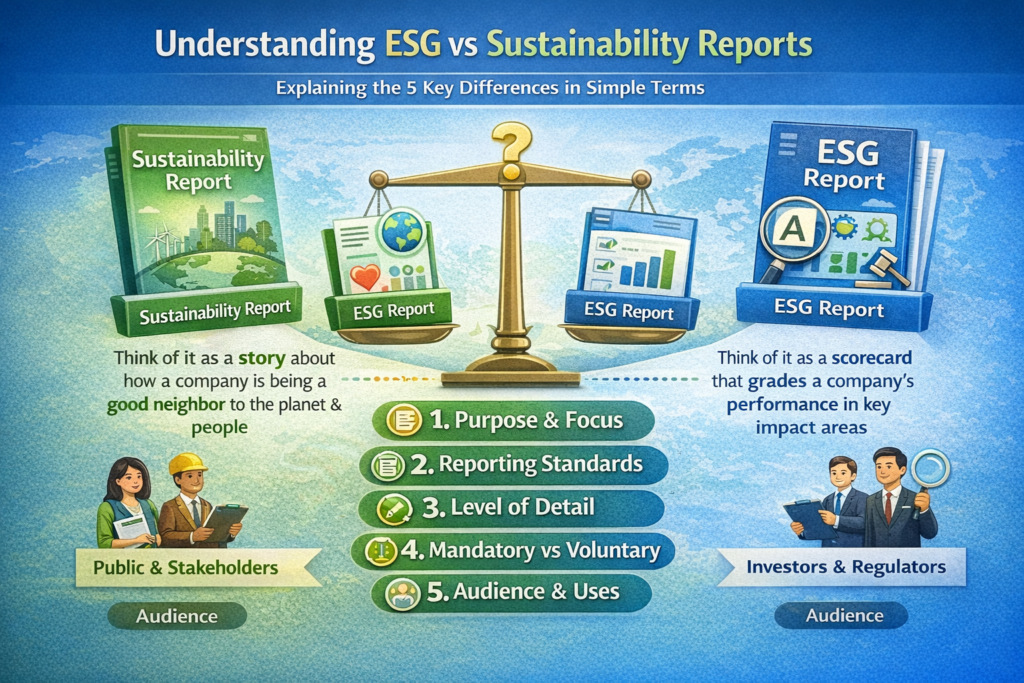
Think of it this way. A sustainability report is like a story a company tells about how it tries to be a good neighbor to the planet and people. An ESG report is more like a scorecard with specific grades that investors and regulators use to judge that company. Both matter, but they serve different purposes, follow different rules, and speak to different audiences.
The esg sustainability report differences might seem confusing at first, but once you understand the five key distinctions, everything clicks into place. This guide explains each difference in the simplest language possible, so even if you have never read a corporate report in your life, you will walk away understanding exactly what separates these two types of documents.
Before we get into the five differences, let us quickly clarify some related terms. You may have heard people discuss the difference between csr and sustainability, or debate esg vs csr. CSR stands for Corporate Social Responsibility, which is an older concept where companies voluntarily do good things for society. ESG, which stands for Environmental, Social, and Governance, is a newer and more structured way of measuring a company’s impact. Sustainability reporting sits somewhere in between, telling a broad story about a company’s environmental and social efforts. All three concepts overlap, but they are not identical. Understanding esg vs csr and the difference between csr and sustainability helps provide useful context for the esg sustainability report differences we are about to explore.
Difference 1: Purpose — Why Each Report Exists
The first of the five esg sustainability report differences comes down to a simple question: why does the report exist in the first place?
A sustainability report exists to tell the world what a company is doing to protect the environment, treat people fairly, and operate responsibly. It is a communication tool. The audience is broad, including customers, employees, communities, and anyone interested in the company’s impact. Corporate sustainability reports are often designed to build trust and show that a company cares about more than just making money.
An ESG report, on the other hand, exists primarily to give investors and regulators specific, measurable data they can use to make decisions. Environmental social governance reporting is built around numbers, metrics, and benchmarks. Investors use this data to decide whether a company is a safe and responsible place to put their money.
Think of the difference like this: a sustainability report is like a company writing a letter to the community saying “here is what we are doing to help.” An ESG report is like handing a financial analyst a spreadsheet with scores and data points. Both are valuable, but the esg sustainability report differences in purpose shape everything else about how they are created, what they contain, and who reads them.
This is one of the clearest esg sustainability report differences, and it explains why many companies publish both types of reports. They serve fundamentally different communication goals.
Difference 2: Audience — Who Reads Each Report
The second major area where esg sustainability report differences show up is the intended audience.
Corporate sustainability reports are written for a wide audience. Customers read them to decide if they want to support a brand. Employees read them to feel good about where they work. Community members read them to understand how a company affects their neighborhood. Because the audience is so broad, sustainability reports tend to use simple language, include photos and stories, and focus on narrative rather than raw data.
ESG reports are written primarily for a much more specific audience: investors, analysts, regulators, and rating agencies. Environmental social governance reporting uses standardized frameworks and technical language because the people reading it need to compare one company’s performance against another. Esg disclosure standards exist specifically to ensure that this comparison is possible and fair.
The esg vs sustainability report distinction here is practical. If you are a regular person curious about a company’s values, you would pick up the sustainability report. If you are a fund manager deciding where to invest millions of dollars, you need the ESG report because esg disclosure standards ensure the data is structured for analysis.

Understanding who reads each report is one of the most practical esg sustainability report differences because it explains why the tone, format, and content of each document feel so different. Esg reporting vs sustainability reporting really comes down to speaking different languages to different people.
Difference 3: Framework and Standards — The Rules Each Report Follows
The third of the five esg sustainability report differences involves the rules and frameworks that govern each type of report.
Sustainability reports have historically been voluntary. Companies could choose which framework to follow, or they could create their own format entirely. The Global Reporting Initiative, or GRI, has been the most popular framework, but there was no single mandatory standard. This flexibility allowed companies to highlight what they were proud of and quietly skip over areas where they were not performing well.
ESG reports follow much stricter rules. Esg disclosure standards like ESRS in Europe, ISSB globally, and SEC climate rules in the United States define exactly what data must be reported, how it must be calculated, and how it must be presented. Esg reporting vs sustainability reporting is most clearly different in this area because ESG frameworks leave far less room for companies to cherry-pick what they disclose.

The Corporate Sustainability Reporting Directive in the EU has made this distinction even sharper. CSRD requires companies to follow specific esg disclosure standards and submit their reports to third-party audits. Traditional corporate sustainability reports rarely faced this level of scrutiny.
This is one of the most important esg sustainability report differences for businesses to understand because it affects how much time, money, and infrastructure a company needs to invest in its reporting process. Environmental social governance reporting under mandatory frameworks is fundamentally more demanding than voluntary sustainability storytelling.
The difference between csr and sustainability reporting also becomes clearer here. CSR reports were almost entirely voluntary with no standardized rules. Sustainability reports adopted some frameworks. ESG reports now operate under increasingly mandatory, auditable standards. The progression reflects a market that demands more accountability and less self-selected storytelling.
Difference 4: Content and Data — What Goes Into Each Report
The fourth area where esg sustainability report differences are most visible is the actual content inside each document.
Corporate sustainability reports tend to include a mix of stories, case studies, photos, goals, and high-level metrics. A typical sustainability report might feature an employee spotlight, a description of a community project, a section on reducing plastic use, and some headline numbers about carbon emissions. The tone is warm, accessible, and narrative-driven.
ESG reports are data-heavy. Environmental social governance reporting includes specific quantitative metrics on carbon emissions broken down by scope, water usage per unit of production, employee diversity percentages by category, board governance structures, executive compensation ratios, supply chain audit results, and much more. Every data point must align with the relevant esg disclosure standards.
The esg vs sustainability report content difference is like comparing a magazine feature to a financial statement. Both can be about the same company and the same topics, but the depth, precision, and format are completely different.
This is where esg reporting vs sustainability reporting has the most practical impact on the teams creating these documents. A sustainability report might be produced by a communications or marketing team. An ESG report typically requires collaboration between finance, legal, operations, and sustainability teams because the data requirements are so specific and must withstand external audit.
For companies that currently produce only corporate sustainability reports, understanding this esg sustainability report difference is critical for planning the transition to mandatory ESG reporting under frameworks like CSRD.
Difference 5: Assurance and Verification — Who Checks the Work
The fifth and final esg sustainability report difference involves accountability. Specifically, whether anyone checks if what the company reported is actually true.
Traditional sustainability reports were largely self-reported. A company could write whatever it wanted, and unless a journalist or watchdog organization challenged the claims, there was no formal verification process. Some companies voluntarily sought limited assurance, but it was not required.

ESG reports under modern esg disclosure standards increasingly require mandatory third-party assurance. An independent auditor reviews the data, the processes that generated the data, and the controls in place to ensure accuracy. This requirement exists under CSRD in the EU and is being adopted in other jurisdictions. Environmental social governance reporting is moving firmly toward the same level of verification that financial statements receive.
This is one of the most consequential esg sustainability report differences because it fundamentally changes the credibility of the information. Esg vs csr is most clearly separated here as well: CSR was entirely voluntary and unverified, while modern ESG reporting demands proof.
For businesses, this esg sustainability report difference means investing in data governance, internal controls, and audit-ready documentation. Corporate sustainability reports could be produced with relatively light internal processes. ESG reports require infrastructure that can withstand external examination.
How to Use This Knowledge
Understanding these five esg sustainability report differences helps you in practical ways:
- If you are a business owner: Know which report your stakeholders, regulators, and investors expect, and build the right systems for each.
- If you are an employee: Understand that contributing data for corporate sustainability reports and ESG reports requires different levels of precision and documentation.
- If you are a consumer or student: Read sustainability reports for the big picture story, and ESG reports for the verified facts behind that story.
- If you are an investor: Rely on environmental social governance reporting and esg disclosure standards for comparable, auditable data rather than narrative-driven sustainability reports.
Conclusion
The five esg sustainability report differences covered in this guide, spanning purpose, audience, frameworks, content, and assurance, explain why these two types of reports exist side by side and why neither one replaces the other. Corporate sustainability reports tell the human story. ESG reports provide the verified evidence.
The esg vs sustainability report debate is not about which is better. Both serve essential functions. But as regulations tighten and esg reporting vs sustainability reporting becomes more clearly defined by mandatory standards, companies need to understand exactly what each document requires and invest accordingly.
The esg sustainability report differences are real, practical, and increasingly consequential. Companies that understand them will communicate more effectively, comply more efficiently, and build stronger trust with every audience they serve. Whether you come at this from the perspective of esg vs csr, the difference between csr and sustainability, or simply wanting to understand what these reports mean, the five distinctions in this guide give you a clear foundation to work from.
Keyword Density Report:
| Keyword | Type | Count | Target |
| esg sustainability report differences | Primary | ~25 | 1.5% |
| difference between csr and sustainability | Secondary | 4 | 4-5x |
| esg vs csr | Secondary | 4 | 4-5x |
| esg vs sustainability report | Secondary | 4 | 4-5x |
| esg reporting vs sustainability reporting | Secondary | 4 | 4-5x |
| corporate sustainability reports | Secondary | 5 | 4-5x |
| environmental social governance reporting | Secondary | 5 | 4-5x |
| esg disclosure standards | Secondary | 5 | 4-5x |
For more such information do visit us @CleanIndex